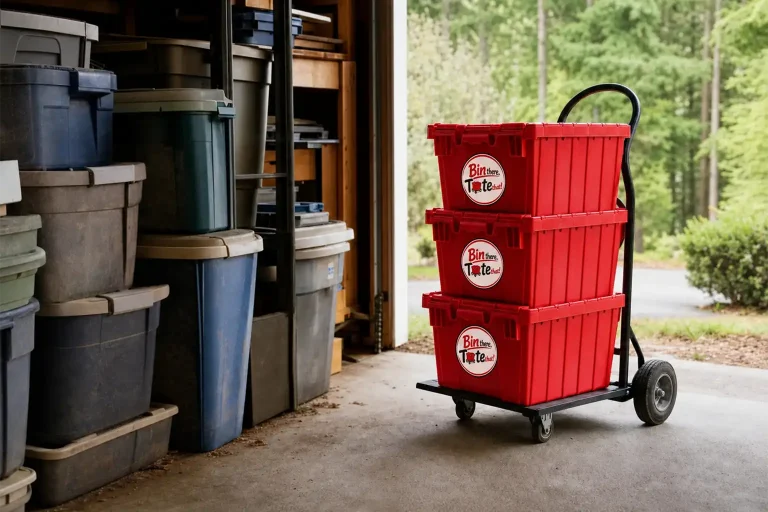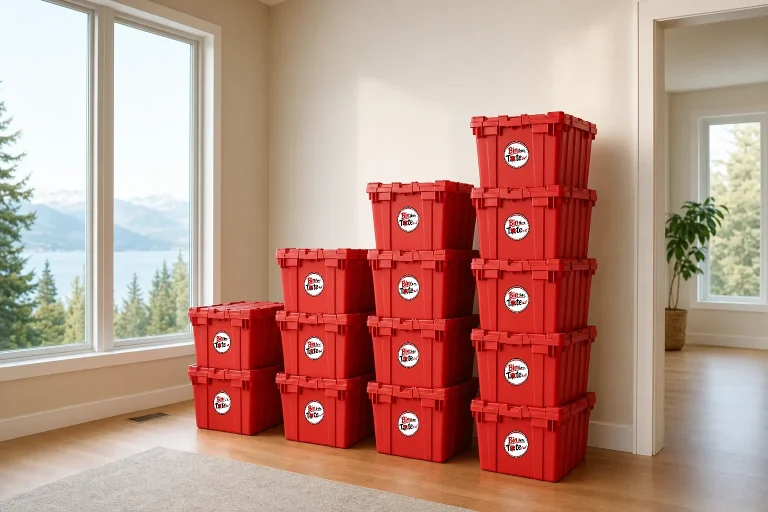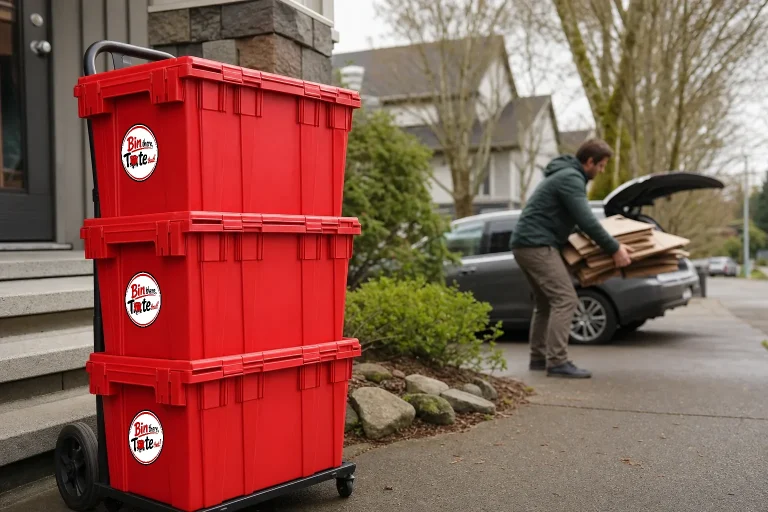
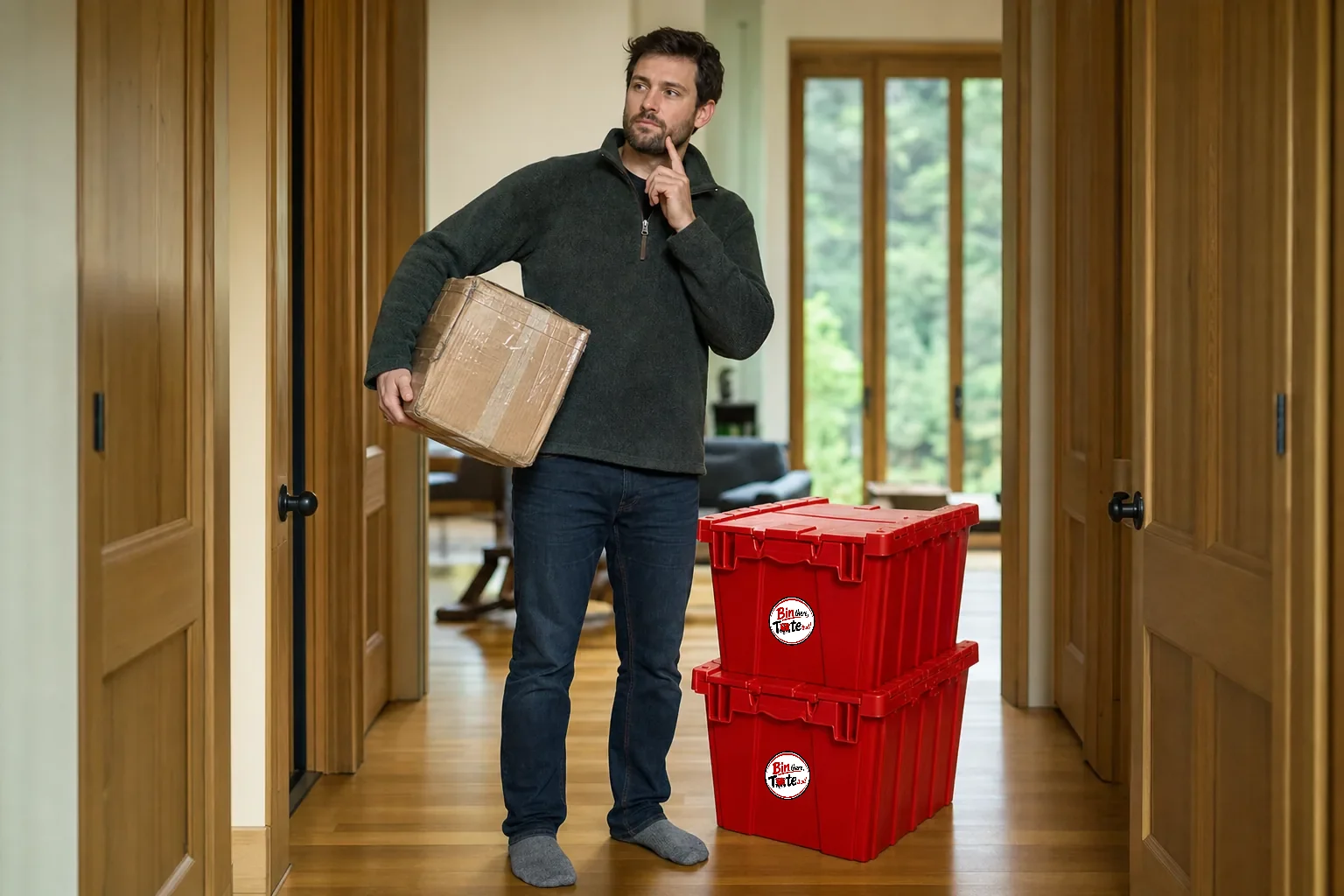
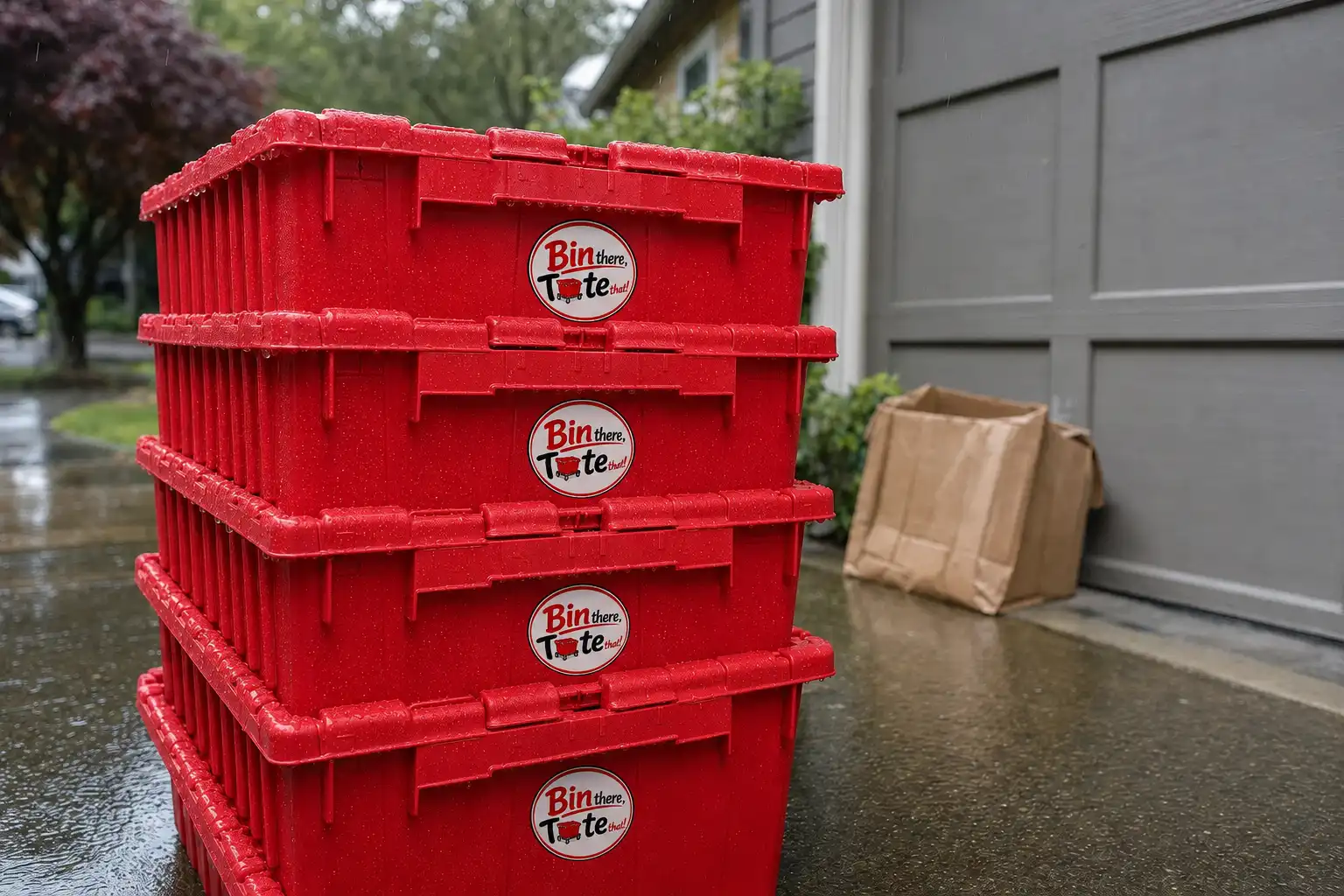
For most local household moves, yes: plastic moving bins are worth it. They stack without crushing, shrug off rain, need no assembly or tape, and load into a truck in clean uniform columns, and renting them means they vanish after the move instead of colonizing your garage. In Portland and Vancouver, Bin There, Tote That! delivers them free in flat packages from $97 to $257 with a hand truck included and free pickup after two weeks, as of July 2026.
The answer is no in four cases: a move small enough to fit in a car, belongings headed into weeks of transit or long-term storage, a household made mostly of odd shapes, or a mover with free boxes and abundant time. Bins solve a logistics problem; if your move does not have that problem, keep your money.
What people mean by plastic moving bins
Plastic moving bins are rigid, lidded crates used in place of cardboard for a move. They come into your life one of two ways: you buy them from a big-box store and own them afterward, or you rent them from a service that drops off a clean stack before you pack and takes it back when you are done. This post covers both, because "worth it" depends heavily on which route you mean, and search results tend to blur them together.
Around Portland, the rental route looks like this: Bin There, Tote That! delivers washed, sanitized totes in four flat-rate packages from $97 to $257, includes a standard hand truck, and collects everything from your new address after a two-week window, with delivery and pickup free across the Portland and Vancouver metro.
The benchmark: what bins are up against
The alternative is the default everyone knows: cardboard, either bought new in bundles or scavenged free from stores and friends. Cardboard sets a low bar on price per container and a high bar on flexibility. It comes in a dozen sizes, folds flat until needed, cuts down with a knife, and can be recycled or hoarded afterward. Any honest answer about bins has to beat cardboard where it matters and admit where it does not.
Notice what that framing does: it turns a product question into a fit question. Bins are not better or worse than cardboard in the abstract. They are better for certain moves and wrong for others, and the line between those moves is surprisingly easy to draw.
Worth it or not, at a glance
Here is the fit question compressed into one table.
| Factor | Cardboard | Rented plastic bins |
|---|---|---|
| Crush protection | Bottom box in a stack carries the load in its walls | Rigid shell takes the stack, contents ride unbothered |
| A wet moving day | Absorbs rain and loses structural integrity with it | Water beads off the lid, which in Portland earns its keep |
| Setup work | Fold, square, tape bottom, tape top, sixty times | Open lid, fill, close lid |
| Loading the truck | Mixed sizes create gaps and improvised jenga | One footprint, clean columns, no wasted air |
| Odd-shaped cargo | Cuts, folds, and comes in specialty formats | Fixed shape, so lamps and rugs need another plan |
| After the move | Yours to flatten, recycle, or store indefinitely | Collected from your new address, then gone |
| Long-term storage | Fine, if kept dry and off concrete floors | Rentals go back in two weeks, so no |
The advantages that hold up under use
Four bin benefits survive contact with an actual moving day, and they are worth spelling out because they compound.
Rigidity comes first. A stack of loaded totes is a stable column; a stack of loaded cardboard is a slow-motion experiment. That difference decides how confidently a truck gets packed and how many trips the dolly makes per run. Weather comes second, and around here it is not hypothetical. A lid that sheds rain means the driveway leg of your move stops being a gamble on the forecast. Third is the missing setup phase: no assembly, no taping, no re-taping the heavy ones. Fourth is hygiene, which secondhand cardboard cannot promise. Rental totes from a professional fleet arrive cleaned and sanitized, not smelling of someone else's garage.
There is a fifth advantage that only shows up on moving day itself: speed of handling. Uniform containers with molded grips and flat lids move faster per trip, whether the hands belong to you, your friends, or an hourly crew. If you hired movers, the meter is running while they solve cardboard geometry in the truck, so containers that stack themselves quietly pay back part of their own fee.
For most moves, yes. For yours, maybe.
When the honest answer is no
Now the part most rental companies skip. There are moves where plastic bins are the wrong call, and pretending otherwise would make the rest of this page worthless.
- The tiny move. If everything you own fits in a car and a friend's hatchback, even the smallest package is more container than you need. A dozen scavenged boxes will do fine, and we would rather tell you that than rent you overkill.
- The slow, long-distance move. Rentals run on a two-week window with pickup in the metro. If your belongings are crossing three states or sitting in transit for a month, buy your containers or use cardboard. The logistics simply do not fit.
- The storage project. Packing a unit for a year is ownership territory. A rented bin that goes back in fourteen days cannot hold your camping gear until spring, and a bought bin or sturdy cardboard can.
- The odd-item-heavy household. Fixed dimensions are a strength until they meet floor lamps, framed art, and hanging wardrobes. Totes carry the bulk of any home, but a household that is mostly awkward shapes will lean harder on blankets and specialty boxes than on bins of any kind.
Rent them or buy them?
If bins do fit your move, one decision remains, and it hinges on what happens after moving day. Buying makes sense when the bins have a second career ahead: garage shelving, seasonal storage, the next move already visible on the horizon. You pay more up front, then own the containers.
Renting makes sense when you want the container era of your life to end on schedule. The stack arrives before packing, leaves after unpacking, and never claims a corner of the new garage. It also front-loads none of the labor: with delivered tote rental in Portland and Vancouver, the containers show up at your door with the dolly, and the return trip is our problem. The full decision gets its own treatment in our renting versus buying breakdown; the short version is that a single move favors renting and a storage habit favors buying.
The verdict, with its exceptions attached
Here is the whole post as a fork in the road.
- The whole move fits in one car load
- Your things will sit in storage or transit for weeks
- Your load is mostly lamps, art, and awkward shapes
- You are moving a real household within the metro
- Two weeks covers your pack, move, and unpack
- Stacking, rain, and zero assembly would help your week
- You never want to see the containers again afterward
If you landed on the rental side, the process is four steps and a doorbell, all laid out on the how the rental works page. And if you are still weighing plastic against the cardboard default, the material-versus-material question has its own full hearing in the cardboard boxes versus plastic totes guide.

Written by the Bin There, Tote That! team
We rent, deliver, wash, and pick up moving totes across the Portland and Vancouver metro every week, so the advice here comes from vans and doorsteps, not a content mill. Facts about competitors are checked at publication and date-stamped in the text.