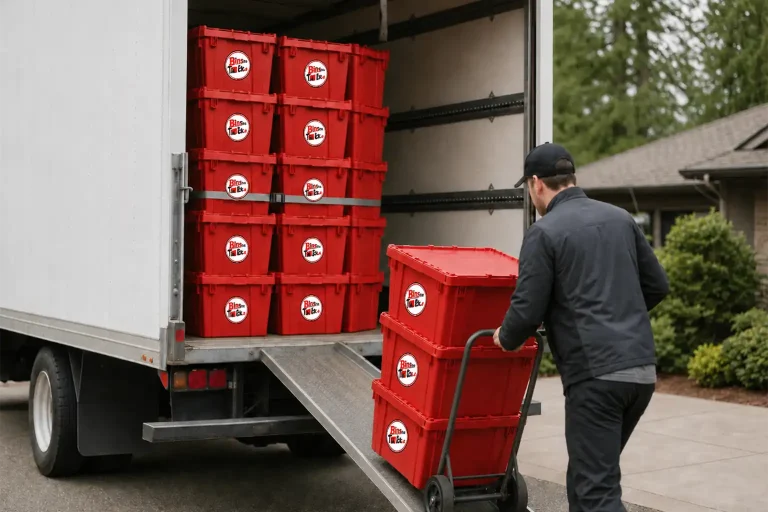

A small-office relocation in Portland runs on an eight-week timeline with one named coordinator, and it optimizes for a single metric: a normal-looking Monday morning. The load-bearing practices are an IT teardown done as label-photograph-bag per workstation, a documented chain of custody for sensitive files, and the desk-per-employee container method, where each person packs and unpacks their own numbered totes.
Execute the physical move after hours or over a weekend, with freight elevators booked and both buildings' insurance requirements confirmed in writing. Commercial tote rental supplies the container layer: sealed, stackable, delivered to the old office free and collected from the new one, with business quantities arranged by phone.
The small-office relocation timeline
An office move is a project with a payroll attached, which changes the arithmetic. Every hour the business is packed but not unpacked, you're paying people to not quite work. So the plan optimizes for one number: how quickly Monday morning looks normal again. For a small office of five to twenty-five people, eight weeks of runway is comfortable, six is workable, and four is possible with discipline and forgiveness.
| Weeks out | Workstream | Owner |
|---|---|---|
| 8 | Lease terms confirmed both ends; move date set; one person named move coordinator | Leadership |
| 6 | Floor plan for the new space, desk assignments, vendor and mover quotes gathered | Coordinator |
| 4 | Internet and phone service ordered at the new address; purge of dead equipment and expired files begins | Coordinator + IT |
| 2 | Containers delivered, labeling system issued, building requirements at both ends confirmed in writing | Coordinator |
| 1 | Non-essentials packed; IT freeze scheduled; employees pack their own desks Friday afternoon | Everyone |
| 0 | Move executed over the weekend; IT rebuilds Sunday; doors open Monday | Coordinator + crew |
The single most valuable row is the first one: name a coordinator. Committees do not move offices. One accountable person with a spreadsheet does, and everyone else follows their labels.
IT teardown: label, photograph, bag
The most expensive hour of an office move is the Monday-morning hour when nobody's monitor works. Nearly all of it traces back to teardown shortcuts. The discipline is mechanical and it never varies.
- Photograph every desk setup before touching a cable: rear of the machine, monitor ports, dock, the under-desk spaghetti. Thirty seconds per desk.
- Label both ends of every cable with the desk number before unplugging. A cable labeled on one end is a riddle at the new site.
- Bag per machine, not per room. Each workstation's cables, dock, and mouse go in one zip-top bag, labeled with the same desk number, taped to that machine or riding in that desk's container.
- Back up before anything moves. Machines get dropped rarely, but rarely is not never, and the week of a move is the wrong week to discover which backups were aspirational.
- Servers and network gear travel last out and first in, handled by whoever will rebuild them, ideally on Saturday so Sunday is testing rather than triage.
Downtime is the real moving cost. Not the truck.
Chain of custody for files
Personnel records, contracts, client files, and financials cannot ride in an open box on whoever's truck. If the business handles regulated or confidential material, the move needs a documented chain of custody: sealed containers with numbered labels, a manifest of which files are in which container, one named person who signs them out of the old office and signs them in at the new one, and no overnight stops in anyone's garage.
This sounds heavier than it is. In practice it's an hour with a spreadsheet, a marker, and containers that actually seal. It also answers, in advance, the awkward question a client or auditor may someday ask about where their records spent moving weekend. Anything past retention gets shredded before the move rather than after; there is no better forcing function for a records purge than a per-container count.
The desk-per-employee tote method
Here is the system that keeps an office move from becoming a lost-and-found. Each employee receives containers assigned to their desk number, packs their own workstation Friday afternoon, and unpacks it themselves Monday morning. Nobody packs anyone else's desk; nobody's headphones enter the communal void. The coordinator's floor plan maps desk numbers to new locations, so the unload crew delivers each stack to the right desk without asking a single question.
Rigid totes suit this method better than cardboard for reasons an office makes obvious: they seal without tape, stack in uniform columns against a wall without crushing, and roll on a hand truck through a freight corridor in batches. We supply commercial quantities of totes to Portland and Vancouver businesses with the same free delivery and free pickup as our residential packages, delivered to the old office and collected from the new one; terms and quantities for commercial runs are arranged case by case. For a sense of the standard packages and rates, the package rate table is public, and it takes one call or text to scope a business order.

After-hours and weekend moves
Almost every office move worth planning happens outside business hours, and the buildings know it. Commercial buildings at both ends will usually require the freight elevator to be booked, may restrict moves to evenings or weekends, and commonly require a certificate of insurance from your movers before anyone touches the loading dock; get both buildings' requirements in writing from property management early.
Downtown Portland adds its own texture: loading docks shared with neighboring tenants, one-way streets that complicate truck staging, and event nights that can close curb access you assumed. Scout the dock at the new building at the same hour your move will run, not at noon. If the truck itself is yours to load, the geometry rules in our guide to loading a moving truck properly apply doubly when the cargo is forty identical containers and a server rack.
Minimizing downtime
The businesses that reopen smoothly on Monday all did the same four things. They moved the week's critical functions first, meaning the coordinator identified the five machines and two phone lines that make money and rebuilt those before any bookshelf. They had internet live at the new office before moving weekend, ordered weeks earlier, because installation windows do not respect move dates. They ran the old office skeleton-thin on Friday rather than packing mid-week and working from boxes for days. And they told clients, in advance, that Friday afternoon would be quiet, which cost nothing and bought patience.
A same-metro move rewards this discipline generously: with the old and new offices both inside the Portland area, a weekend is genuinely enough, and by Monday the only evidence is a wall of sealed totes waiting for collection, a pickup that doesn't cost your staff a trip since collection is free at the new address.
Move it yourselves, or hire commercial movers?
Small offices genuinely can self-move; there is a size where that stops being thrift and starts being false economy. The honest fork:
- You're under roughly ten desks with no specialty equipment
- Neither building demands a mover's certificate of insurance
- Furniture is modular and the team is willing, in writing, on a weekend
- Server racks, copiers, or anything requiring two careful strangers is moving
- Either building requires a COI or a certified crew at the dock
- The math says staff hours cost more than the movers' invoice
- Monday absolutely cannot slip
Either way, the container layer stays the same: numbered, sealed, desk-assigned totes moving through a labeling system worth setting up properly; our breakdown of labeling systems that survive contact with moving day transfers directly to office use, the master relocation checklist adapts cleanly to a business timeline, and the broader moving guide series covers the questions this one didn't.

Written by the Bin There, Tote That! team
We rent, deliver, wash, and pick up moving totes across the Portland and Vancouver metro every week, so the advice here comes from vans and doorsteps, not a content mill. Facts about competitors are checked at publication and date-stamped in the text.