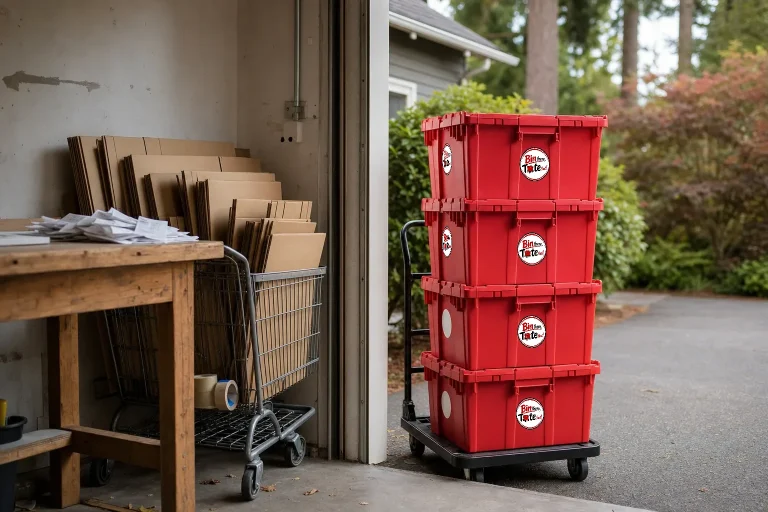
Lowe's sells decent cardboard moving boxes per box and per bundle, usually purchased as an add-on to a project run, which is exactly why the quantities and sizes so often miss. Renting plastic totes from Bin There, Tote That! costs a flat $97 to $257 for two weeks, with counts matched to home size, free delivery and pickup across the Portland-Vancouver metro, and a hand truck included, as of July 2026.
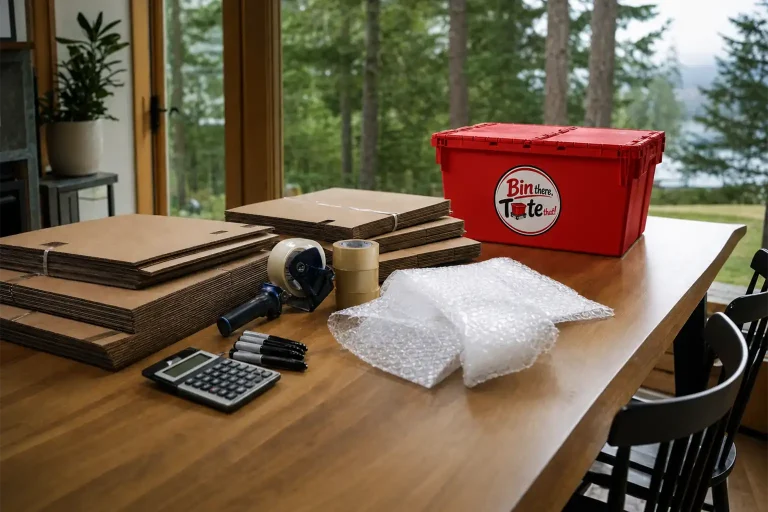
On pure cost, a few cardboard singles win tiny moves. For whole homes, the full kit of boxes, tape, and cushioning plus cardboard's habit of softening in damp Northwest air tends to cost more than the package, and stacks of rigid totes carry weight the way wet-season cardboard can't.
How moving boxes sneak into a Lowe's run
Few people plan a Lowe's trip for boxes. They go for paint, a faucet washer, or bark dust, and somewhere between departments the upcoming move taps them on the shoulder. The moving section is right there, cardboard in every size, sold by the box and by the bundle, and the logic feels airtight: I'm already here, the truck's already parked, boxes now save a trip later.
That's the weekend-project trap. Boxes bought as a side quest get bought without a plan: no room-by-room count, sizes chosen by shelf position, quantity chosen by what fits over the paint cans. Lowe's prices its boxes individually and in multi-packs, with rates that vary by store, so confirm current pricing on the shelf tag rather than trusting anything a blog tells you. What no shelf tag shows is whether forty impulse boxes are the right forty for your actual house. The usual discovery comes ten days later, mid-pack, when the kitchen alone has consumed the mediums and the closet hasn't started, and the truck now needs a detour through the parking lot you just left.
The alternative that arrives on purpose
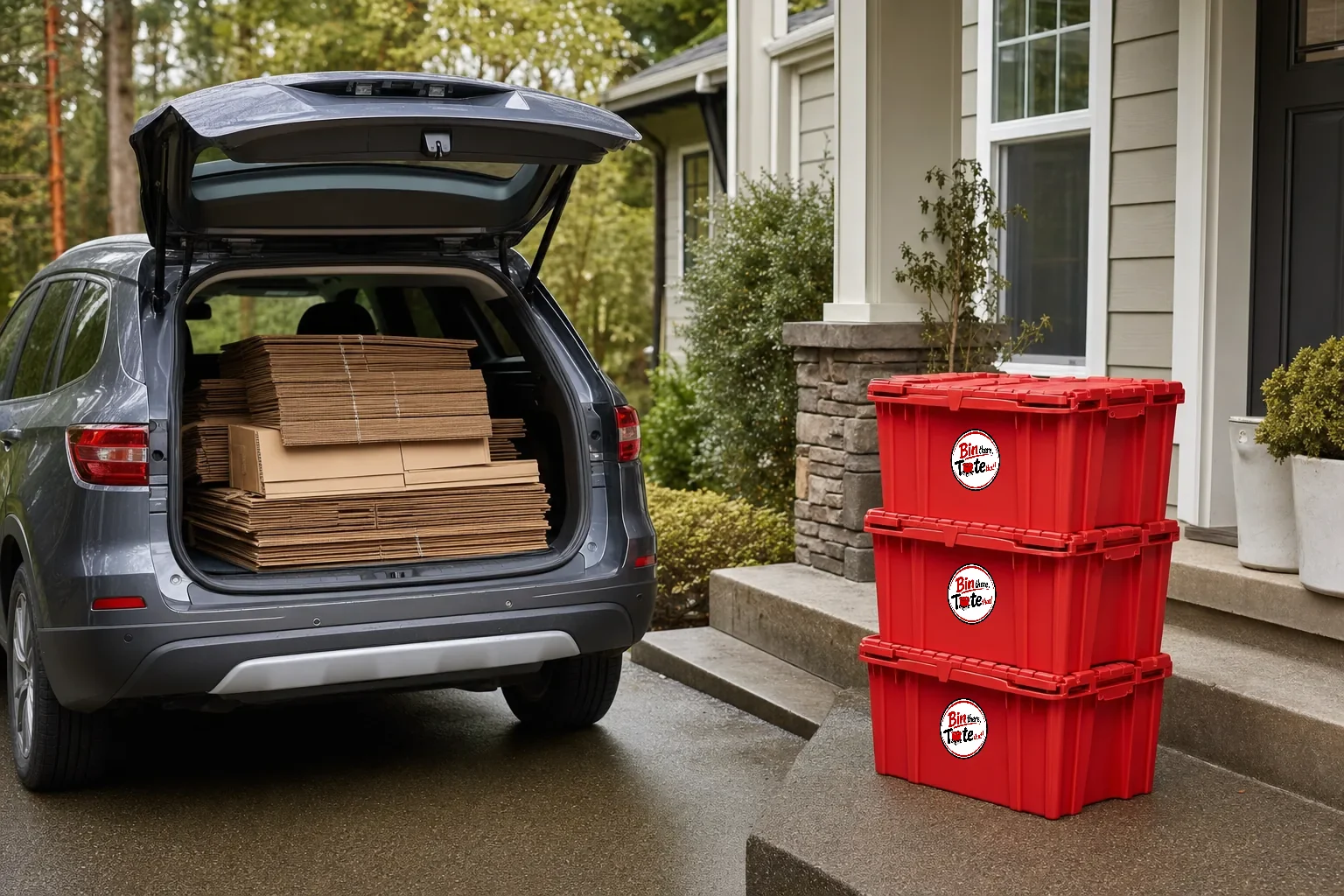
A tote rental is the opposite of an impulse aisle. You match your home size to a package, 10 totes for $97, 25 for $127, 50 for $197, 75 for $257, and Bin There, Tote That! delivers the stack free to any Portland or Vancouver metro address with a standard hand truck included. Two weeks later the empties leave from your new place, also free. The counts were built from real moves, so the guesswork that haunts the store run is done before you book. Current numbers live on the package pricing page.
Delivery day is unglamorous by design: a stack of clean crates lands where you point, the hand truck leans against it, and the driver leaves. No folding, no tape run, no debating whether the bundle fits over the paint cans. The planning already happened, which is the one supply the moving aisle doesn't carry.
The physics: crush strength vs. column strength
Here's the part of the comparison that never makes it onto a shelf tag. Cardboard strength is rated by edge crush test, which measures how much load the walls take before they buckle. Fresh, dry board scores respectably. Then Portland happens to it. Corrugated board absorbs moisture from damp air, and damp fibers lose stiffness, which is why a box that felt rigid in the store goes soft in a garage by the Willamette in November. Stack heavy on top of softened, and the bottom box folds.
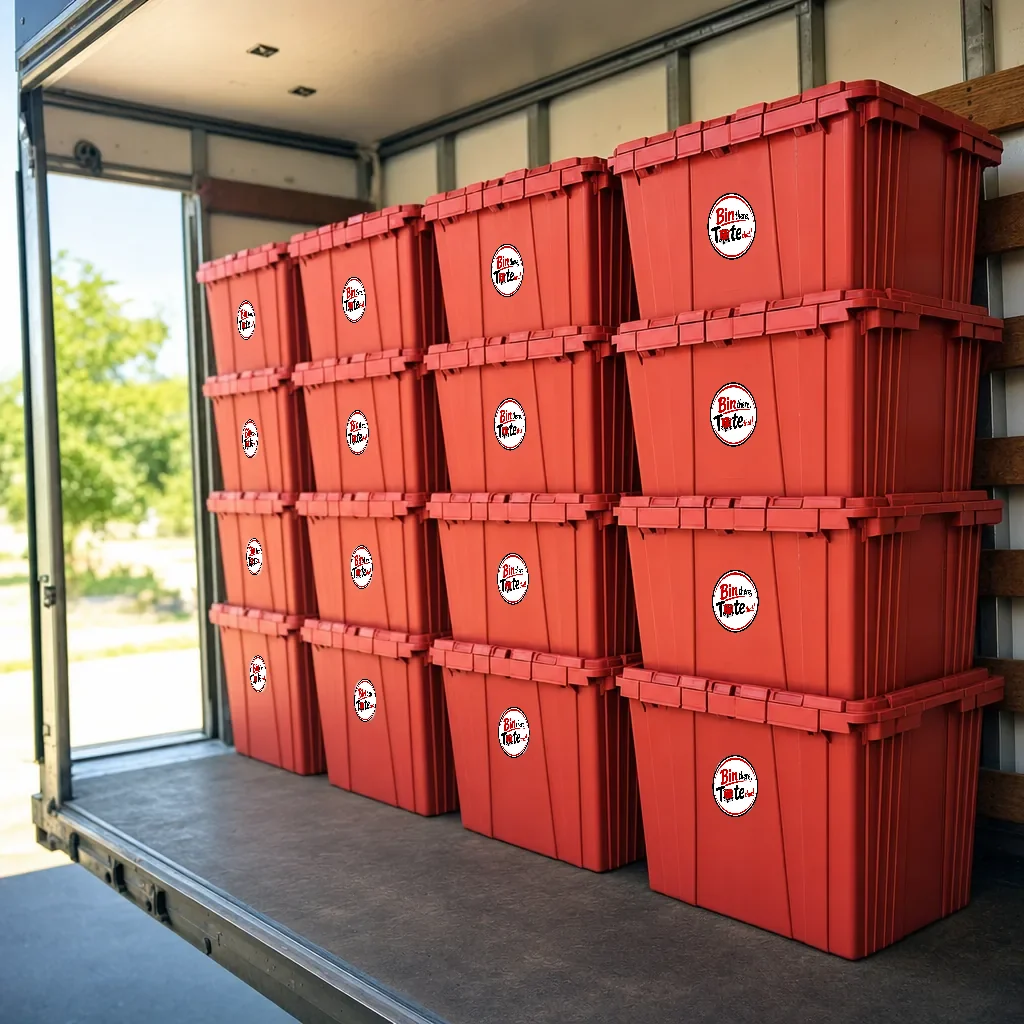
Rigid plastic totes carry load through their molded corners rather than paper walls, and the units nest into each other's lids, so weight travels down clean vertical columns. In a truck that means stacks that hold to the ceiling without a pyramid strategy, and stacks that are still the same shape when the door rolls up at the new place.
The gap widens if your belongings wait anywhere between homes. Cardboard under sustained load slowly creeps: a stack that looked fine on day one lists sideways by week three in a storage unit, because the bottom boxes keep compressing long after loading day. Closing dates slip, lease overlaps happen, and plenty of Portland moves include a month in limbo. Containers that hold their shape for that month aren't a luxury; they're the difference between unpacking your dishes and excavating them.
Lowe's boxes vs. rental totes, row by row
The comparison in table form, physics included.
| Factor | Lowe's cardboard boxes | Delivered totes (us) |
|---|---|---|
| How they enter your life | Ride along on a paint-and-plants run | Booked to a package, delivered on schedule |
| Quantity logic | Whatever fit in the cart that day | Counts matched to studio through 4+ bedroom homes |
| Load path | Paper walls rated until they buckle | Molded corners carry weight in columns |
| Damp November garage | Board softens as fibers take on moisture | Plastic doesn't care about humidity |
| Truck stacking | Heaviest low, lightest high, fingers crossed | Nested lids lock stacks straight to the ceiling |
| Price shape | Per box and per bundle, varies by store | Flat: $97, $127, $197, or $257 for two weeks |
| Wheels | Bring your own or buy one nearby | Standard hand truck in every delivery |
| Exit strategy | Flatten and recycle, or feed the garage pile | Collected free from the new address |
Where the Lowe's run earns its keep
The store route has legitimate wins, and pretending otherwise would make this page useless.
- Genuine one-trip efficiency. If the move coincides with real house projects, patching, painting, new blinds for the old place, the boxes genuinely do share a trip you were making. The trap is only a trap when the errand was invented.
- No calendar required. Shelf stock answers a same-day emergency better than any scheduled delivery can.
- Heavy-duty singles for odd jobs. Need two double-wall boxes for shipping a mixer to your sister? Buying two boxes beats renting ten, no contest.
So which actually costs less?
Run the decision in order and the answer falls out by itself.
- Count the containers honestly. A one-bedroom typically needs a few dozen boxes; larger homes multiply from there. Impulse math undercounts, then pays twice.
- Price the whole kit. Boxes plus tape plus cushioning plus any repeat trips, at your store's current rates. That's the real cardboard number, not the per-box tag.
- Price the failure risk. One buckled box of dishes can erase everything the cheap route saved. Cardboard's cost curve includes breakage odds; a rigid crate's doesn't.
- Compare against the flat package. $127 covers a typical one-to-two-bedroom apartment with delivery, pickup, and the dolly already inside the number.
For very small moves, cardboard singles win step four. For most whole-home moves, the kit total plus the risk column lands above the package price, and that's before your Saturday gets valued at anything. Price a weekend hour at whatever your job pays and the store route's spreadsheet gains a column most people would rather not see. The long version of this argument, with the Home Depot flavor of the same aisle, is in our Home Depot box-run breakdown.
New cardboard is strong. Stacked cardboard is a wager.
Pick your lane
Both lanes are fine lanes. Just pick one on purpose.
- The trip was already happening for real project supplies
- You need a handful of heavy-duty boxes, not a household's worth
- Your destination is outside the Portland-Vancouver metro
- You're packing dishes, glassware, or anything that hates buckling
- Your stuff will sit in a garage or storage unit between homes
- You want container count decided by data, not cart space
- Free delivery and free pickup sound better than two truck loads of board
If you landed here mid-decision, two more reads finish the picture: how plastic moving box rental works across the metro, and whether cardboard beats totes at all once every factor is on the table.

Written by the Bin There, Tote That! team
We rent, deliver, wash, and pick up moving totes across the Portland and Vancouver metro every week, so the advice here comes from vans and doorsteps, not a content mill. Facts about competitors are checked at publication and date-stamped in the text.