
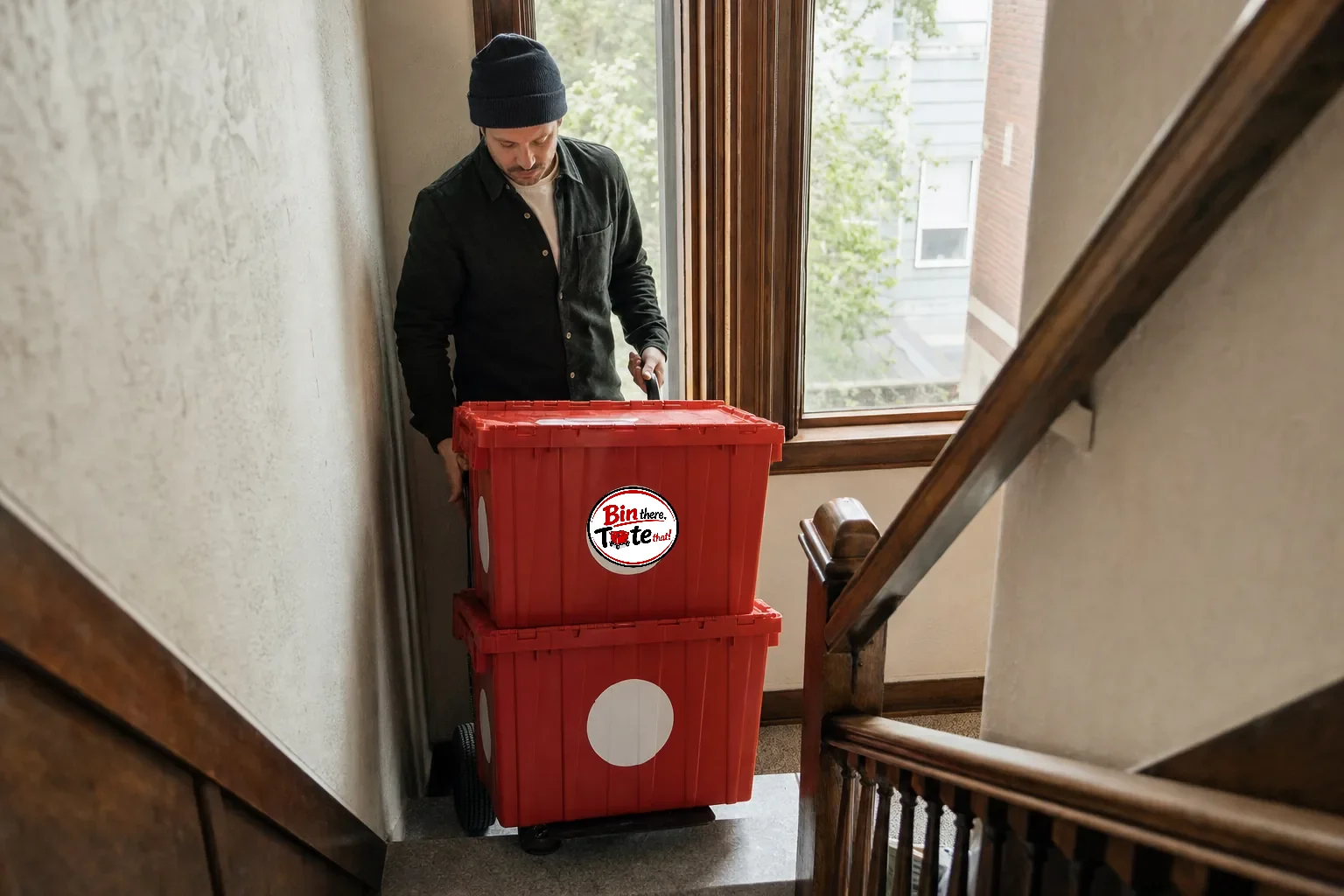
Apartment moves in Portland succeed on three reservations made early: the freight elevator through your building manager (managed buildings often also require a certificate of insurance from hired movers, so request the move-in packet in writing), curb space through PBOT's Temporary Street Use Permit (allow 10 to 12 business days from application to permit start, as of July 2026), and whatever container setup you're using, arranged days ahead rather than hours.
On the day itself, stairs reward a relay system with staging piles at top and bottom, and a hand truck loaded with uniform stacking containers does more to shorten the day than an extra pair of hands. Warned neighbors forgive nearly everything else.
Why apartment moves are their own animal
A house move is measured in miles. An apartment move is measured in vertical feet, and the vertical feet are where plans die. The truck part is easy; the hard part is the seventy steps between the truck and your door, whether those steps are literal stairs, an elevator with opinions, or a half-block of sidewalk you don't control.
Portland makes this its own flavor of interesting. The housing stock runs from 1910 craftsman conversions with staircases built for smaller furniture, to close-in walk-ups with no loading zone in sight, to managed towers in the Pearl and South Waterfront with freight elevators, paperwork, and rules. Each type has a different playbook, and knowing yours two weeks early is worth more than any packing hack.
The move is horizontal. Apartment buildings are not.
Elevators, reservations, and the COI question
If your building has an elevator and a management company, assume there's a process. Most managed buildings want you to reserve the freight elevator (or the padded-out passenger elevator) for a window, and many limit moves to weekdays or specific hours. Some also require a certificate of insurance, a COI, from any professional moving company before it's allowed past the lobby. Requirements vary building to building, so ask your manager for the move-in packet in writing.
Book the elevator the day you know your move date. Popular buildings see move windows go the way of summer campsites, especially around the first of the month. If you're moving yourself, ask specifically whether the COI rule still applies; buildings usually only demand one from hired movers, but "usually" is doing work in that sentence.
| Arrangement | Who you ask | Lead time |
|---|---|---|
| Freight elevator window | Building manager | 1 to 2 weeks, longer near month-end |
| Certificate of insurance | Your movers send it to management | A few business days |
| Street parking reservation | PBOT, online application | 10 to 12 business days, as of July 2026 |
| Tote delivery | Us, by phone or online | A few days ahead of your pack date |
| Neighbor heads-up | You, with a note or a knock | 2 to 3 days |
Stair strategy for walk-ups
Stairs punish improvisation. The efficient stair move is a relay, not a parade of individuals each carrying one lamp.
- Stage at the top. Carry everything from the apartment to a staging pile by the stairwell first. Short trips, no stairs, fast.
- Put your strongest carrier on the stairs and nowhere else. Stairs are the bottleneck; the bottleneck gets the best resource.
- Stage again at the bottom, inside the lobby or doorway, out of the rain.
- Let a third person run dolly loads to the truck. Sidewalk work is fast work when someone owns it.
- Rotate every 45 minutes. Stair legs give out quietly and then all at once.
Measure the tight turn before moving day, not during it. Craftsman conversions in Southeast are famous for landings that accept a couch only after geometry, swearing, and door removal. Ten minutes with a tape measure decides whether the sofa goes up the stairs or gets sold on the sidewalk.
Portland parking: loading zones and permits
Close-in Portland rarely gifts you thirty feet of open curb on a Saturday. You have three options, in ascending order of certainty: circle and pray, stake out a spot with your car overnight and swap the truck in at dawn, or reserve the curb officially.
The official route is a Temporary Street Use Permit from PBOT, which lets you reserve on-street parking for a residential move. The application is online and takes minutes, but the timeline doesn't: between review and the required advance posting of the reservation signs, PBOT advises allowing 10 to 12 business days from application to your permit start date, as of July 2026. Translation: apply the same week you give notice, not the week you move.
Metered districts, permit zones, and streets near bridges or bike corridors all have their own wrinkles, so read the permit conditions rather than assuming. And whatever you arrange, walk the block the night before. A dumpster, a food cart, or a Sunday farmers market can rewrite your loading plan overnight.
The hand-truck advantage
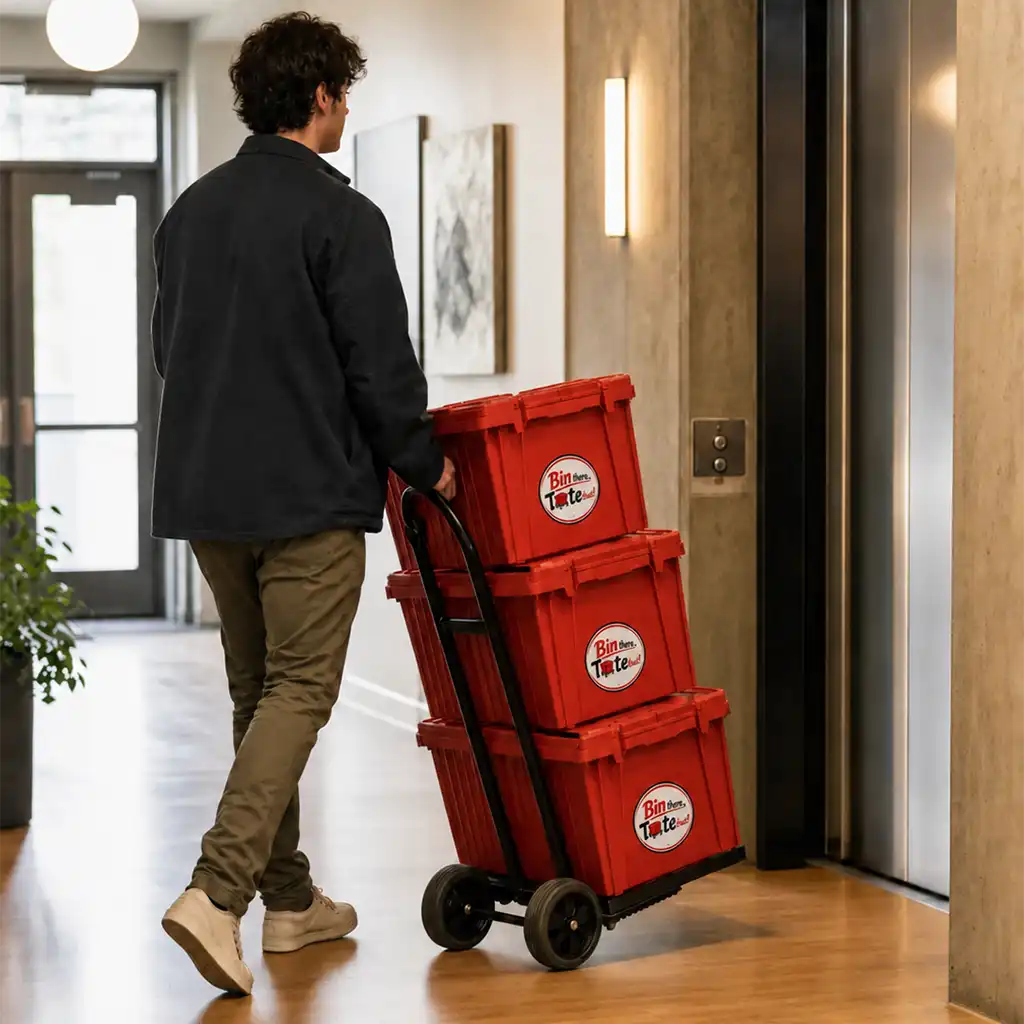
One tool changes apartment-move math more than any other: wheels. A hand truck turns five hallway trips into one, spares your grip strength for the stairs that actually need it, and makes the long corridor from elevator to unit a rolling problem instead of a carrying one.
Wheels want uniform loads, though. A dolly stacked with three same-size containers rolls like a shopping cart; a dolly stacked with a milk crate, a duffel, and a wobbling banker's box rolls like a dare. This is half the reason we built our rental around identical totes: every package comes with a standard hand truck, the totes stack squarely on it three high, and the whole rig fits through a standard apartment door. The delivery itself works the same way at both ends; the four-step rundown shows what arrives and when. Sealed lids also mean a surprise Portland drizzle during the sidewalk leg costs you nothing but a wet jacket.
Neighbor diplomacy
Your move borrows shared space for a day: the hallway, the elevator, the curb, the quiet. A little diplomacy buys a lot of grace. Slip a note under adjacent doors two or three days out with the date and rough hours. Prop doors only with proper wedges, never with someone's welcome mat. Keep the hallway passable between loads; a wall of boxes outside your door is a fire-code problem and a neighbor problem at the same time.
Timing matters too. Starting at 7 a.m. on a Saturday makes enemies; starting at 9 makes acquaintances. If you share a wall with a night-shift nurse, you'll be glad you asked. None of this is required. All of it pays off the first time you need someone to hold an elevator.
Wing it or paper it?
Not every apartment move needs the full bureaucratic stack. Here's the honest split.
- Your building has a private lot or driveway you can use
- It's a small walk-up with no management company in the picture
- Street parking on your block is genuinely easy, even Saturdays
- A management company or HOA runs the building
- You're in a metered or permit-zone neighborhood
- Hired movers are involved and a COI might be demanded
- Your move date sits on the first or last weekend of the month
Logistics sorted, the remaining question is what goes inside the containers. Our walkthrough on packing a one-bedroom on a realistic schedule covers that end, the moving-day playbook covers the day itself, and the rest of our apartment-to-house guide series covers everything in between.

Written by the Bin There, Tote That! team
We rent, deliver, wash, and pick up moving totes across the Portland and Vancouver metro every week, so the advice here comes from vans and doorsteps, not a content mill. Facts about competitors are checked at publication and date-stamped in the text.