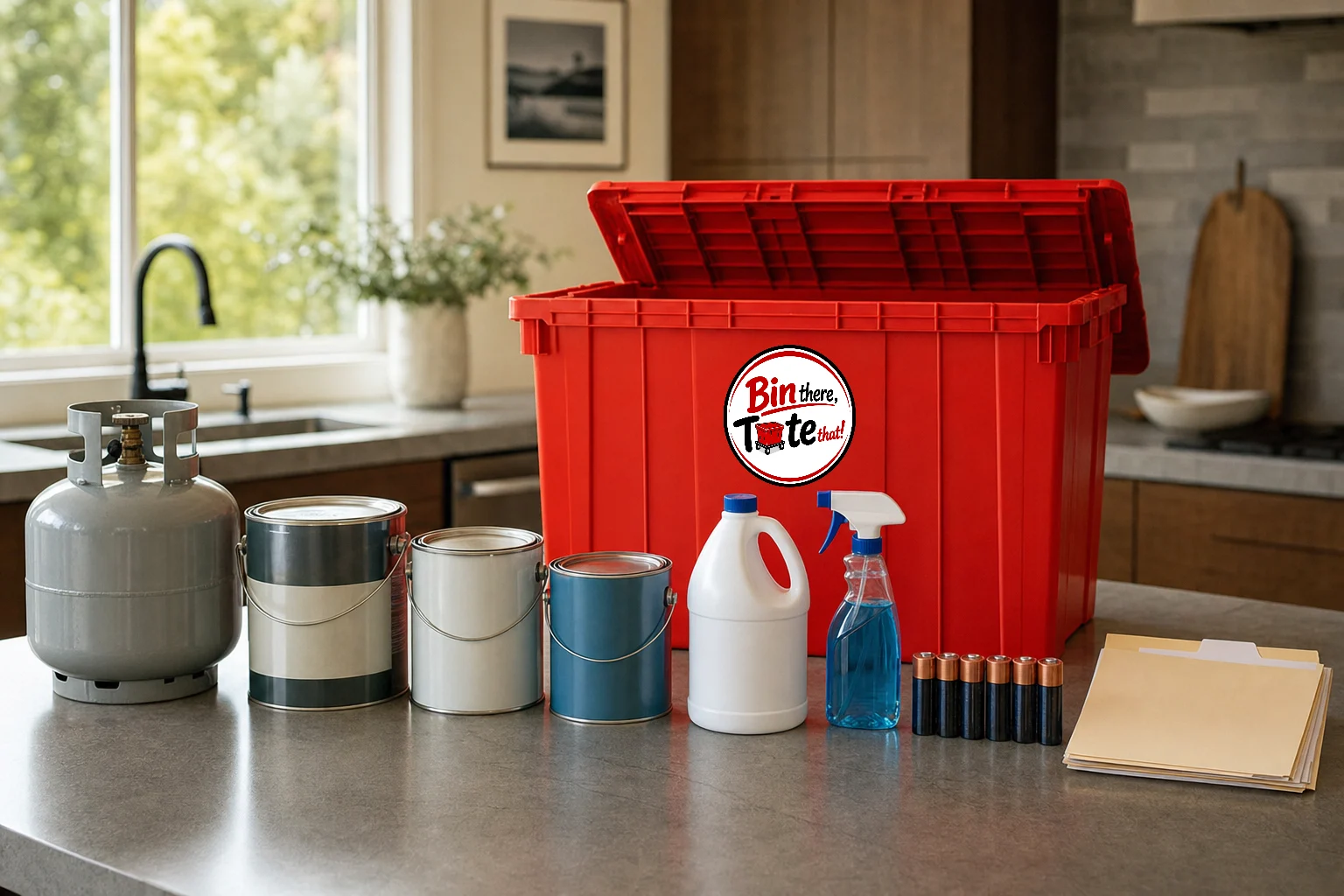
Never pack flammables, chemicals, or pressurized containers in moving boxes or totes: propane, gasoline, aerosols, oil paint, thinners, pool chemicals, and their relatives are refused by movers and container programs as standard industry practice, because a sealed box in a warm truck is where leaks and fires start. Perishable food and live plants also stay out; they rot or die in transit.
Documents, medications, keys, laptops, jewelry, and anything irreplaceable ride in your own car, in one labeled container. In the Portland area, dispose of the hazardous leftovers through Metro's household hazardous waste program rather than the garbage or the drain.
Why some things can't ride in a box
Every moving company, van line, and container rental program keeps a refusal list, and the lists agree with each other almost word for word. That's not lawyers copying homework. It's physics and biology: some items burn, leak, explode, rot, or die inside a sealed container in a warm truck, and some items are simply too important to trust to a vehicle you won't be driving.
The list splits cleanly into four families. Two of them are about danger, one is about mess, and one is about risk you should never outsource. Knowing which family an item belongs to tells you exactly what to do with it instead.
Flammables, chemicals, and pressurized anything
This is the family with the shortest fuse, literally. Propane tanks, gasoline, kerosene, lighter fluid, oil-based paint and thinners, aerosol cans, pool chemicals, pesticides, fertilizer, bleach and ammonia, car batteries, fireworks, and loose ammunition. Movers refuse these as a matter of standard industry practice, and reusable container programs, ours included, expect them kept out of the totes. A sealed plastic box in a hot truck is a fine incubator for exactly the chemistry you don't want.
Don't pour any of it down a drain and don't abandon it in the garage for the next resident, which in most jurisdictions is illegal dumping by another name. In the Portland area, Metro takes household hazardous waste at its two permanent facilities and at seasonal collection events; details live on Metro's household hazardous waste page. Grill owners get one easy win: many propane exchange racks will simply take the old tank off your hands.
Perishables and plants: the mess family
Food that needs a fridge doesn't survive a truck, and even shelf-stable food in opened packages is an invitation to every pest between here and the new pantry. The graceful exit is to stop grocery shopping two weeks out and eat the house down to condiments, then gift or bin what's left on the final morning. Frozen goods either travel in a cooler in your car for a cross-town move or get eaten in a heroic final week of freezer-surprise dinners.
Plants are their own case. A closed box kills them efficiently, by darkness, heat, or tipping, and many professional movers decline to carry them at all. Ferry them in your own back seat, pots wedged upright in an open crate, on the last trip. If you're moving across state lines, some states restrict incoming plants entirely, so check before the fern commits to the journey.
Two appliance footnotes belong in this family. Defrost the freezer at least a day ahead, because a sealed appliance with an inch of meltwater inside will find your truck floor and everything on it. And an aquarium moves empty, always: fish travel in bags or a lidded bucket in your climate-controlled car, the tank travels dry, and the gravel travels in its own container, because a full tank's weight will crack its own seams the first time the truck finds a pothole.
The ride-with-you list: documents and valuables
Nothing on this list is dangerous. It's here because replacement is somewhere between painful and impossible, and because a moving truck is a large unsorted container that you may not reach the bottom of for days. Pack these in one small bag or tote that travels in your own vehicle, every time.
- Identity documents. Passports, birth certificates, Social Security cards, immigration papers.
- The transaction itself. Lease or closing papers, mover contracts, the new keys and garage remotes.
- Money and its cousins. Checkbooks, spare cards, cash for the crew, jewelry, small heirlooms.
- Medications. Every prescription, plus a basic first-aid kit. Pharmacies transfer records, but not by tonight.
- Data. Laptops, backup drives, the family photo hard drive. Cloud backups are great; the physical drive still rides with you.
- Irreplaceables by sentiment. The wedding album, the recipe box in your grandmother's handwriting. Nobody insures those adequately because nobody can.
This list overlaps heavily with your first-night gear, which is why one clearly labeled container in your trunk covers both jobs. Our essentials tote manifest merges them properly.
The full list at a glance
| Category | Examples | What to do instead |
|---|---|---|
| Flammable / pressurized | Propane, gasoline, aerosols, lighter fluid, fireworks | Exchange racks, hazardous waste drop-off, or use it up before the move |
| Chemicals | Oil paint, thinners, pool chemicals, pesticides, bleach | Metro household hazardous waste facilities and events |
| Perishables | Fridge and freezer contents, opened pantry goods | Eat down for two weeks; cooler in your car for the survivors |
| Living things | Houseplants, the sourdough starter, anything in an aquarium | Open crate in your back seat, last trip, climate controlled by you |
| Documents and valuables | Passports, deeds, jewelry, laptops, medications | One labeled container in your own vehicle, door to door |
| The genuinely odd | Firearms, ammunition, anything a mover's contract names | Read the contract; transport per law in your own vehicle or via a licensed carrier |
The ways people get this wrong anyway
Knowing the list isn't the hard part. These are the failure modes that show up even in well-run moves.
The garage gets packed on autopilot. A helper fills totes shelf by shelf, and the half can of acetone ships in the same container as the beach towels. Someone who knows the rules should pack the garage and the under-sink cabinets personally; our garage and tools packing guide walks that room in detail.
"It's only a short drive" reasoning. Distance changes nothing for a leaking can or a cooked laptop battery. The truck gets just as warm crossing the Ross Island Bridge as it does crossing Oregon.
Liquids packed upright and trusted. Shampoo, olive oil, cleaning sprays. Legal to move, ruinous when a cap fails under load. Bag every liquid, and keep them in their own container, never over books or electronics. Screens have their own no-list, covered in the electronics packing guide.
Valuables "hidden safely" in random boxes. Future you will not remember which sock contains the ring. One container, your car, every time.
If losing it would hurt, it rides with you.
Truck or car? The two-question sort
Nearly every packing question in this post resolves with the same quick sort. Run each borderline item through it.
- It can't burn, leak, rot, or die in transit
- Losing it for a week would be annoying, not catastrophic
- It's replaceable at a store for ordinary money
- It's a document, medication, key, or device you'd miss tonight
- It's alive, or it's food you intend to keep
- Its value is sentimental and therefore uninsurable
- A stranger shouldn't be responsible for it, even a careful one
Everything that passes the sort deserves a container worthy of it: sealed, rigid, stackable, and someone else's job to deliver and collect. That's what our plastic tote rental program exists for, and the wider craft of what goes where lives in the rest of our moving guides.

Written by the Bin There, Tote That! team
We rent, deliver, wash, and pick up moving totes across the Portland and Vancouver metro every week, so the advice here comes from vans and doorsteps, not a content mill. Facts about competitors are checked at publication and date-stamped in the text.