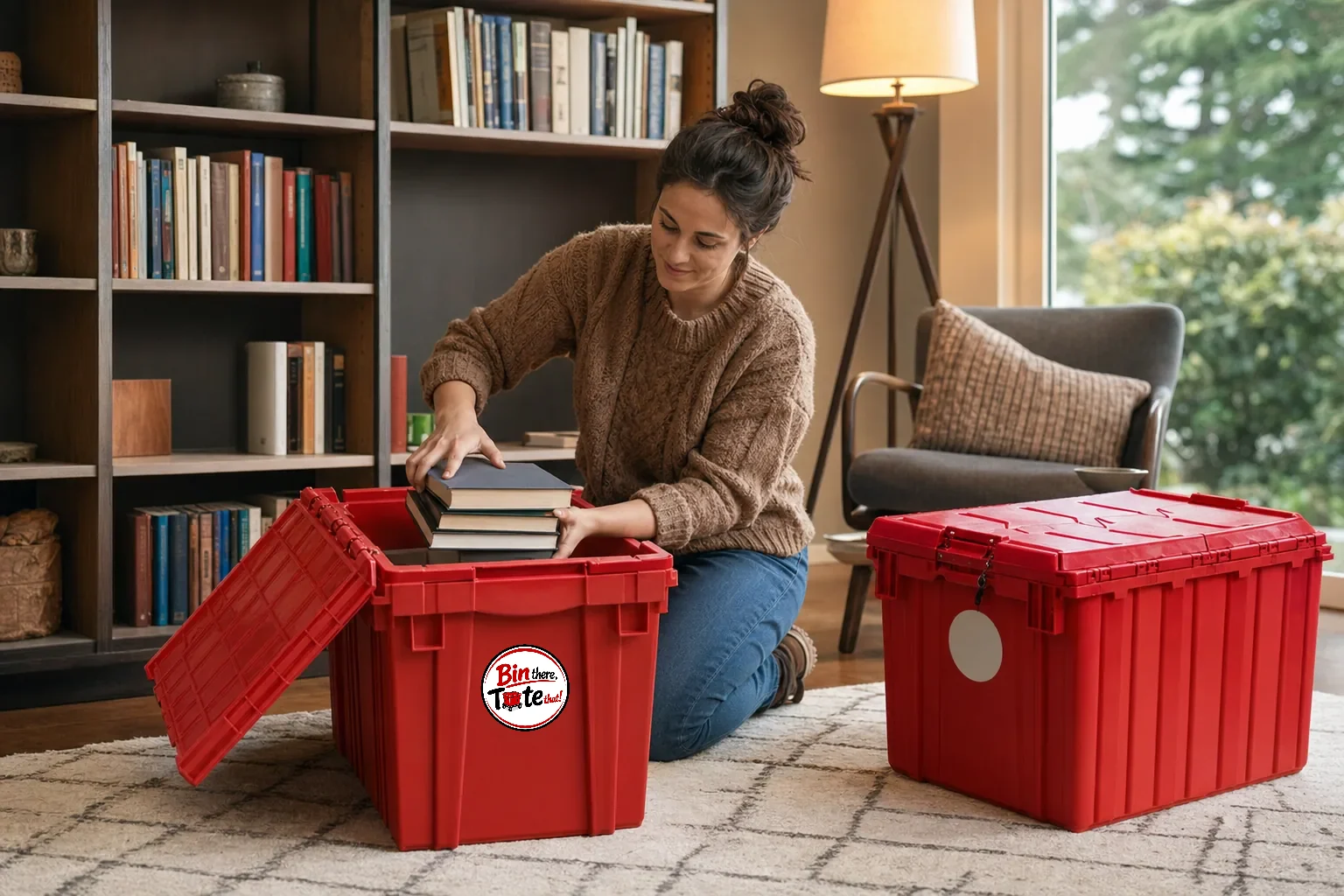
Books are the heaviest common household item for their size, so pack them for weight, not fragility: small loads only, packed flat in stacks or spine-down and never spine-up, with every gap filled so nothing shifts. A large cardboard box filled with books can pass sixty pounds and its taped bottom is the seam most likely to let go mid-carry.
The smartest approach is the bottom-layer strategy: one flat layer of books across the floor of many rigid totes, topped with linens and clothing, so every container carries easy and the library spreads across the whole move instead of concentrating in a few dangerous boxes.
The density problem nobody warns you about
Books are the densest thing a normal household moves. Not the bulkiest, not the most fragile, just relentlessly heavy for the space they occupy. A single hardcover runs a pound or two; a modest bookcase holds a couple hundred of them. Fill a large moving box with paper and you have built something in the range of a loaded suitcase, except with no wheels, no handle, and a taped seam holding the floor together.
That is the entire challenge in one sentence. Packing books is not a fragility problem, it is a weight-management problem, and every rule in this guide exists to keep any single load light enough to carry down a flight of craftsman stairs without drama.
Why big boxes of books fail
The classic beginner move is to fill the largest box available with the entire fiction section. Two things then happen, in order. First, the lift: a big carton of books can pass sixty pounds without looking like it, which is how backs get tweaked on the second trip of the day. Second, the bottom: cardboard seams are tape under tension, tape creeps under sustained load, and a damp November sidewalk finishes the job. The box does not fail in the truck. It fails at chest height, over concrete.
The fixes are old and boring because they work: keep book loads small, keep them dense so nothing shifts, and put paper weight in containers with solid floors. A rigid tote with a molded base has no seam to let go, which is exactly the kind of container this cargo wants.
Books never break. Everything carrying them does.
What book loads actually weigh
Rough numbers, hedged on purpose, but close enough to plan with. Weigh one packed container on a bathroom scale if you want your own baseline.
| Container | Books it swallows | Loaded weight, roughly | Carry verdict |
|---|---|---|---|
| Small cardboard box | 20 to 30 average hardcovers | 30 to 45 lbs | Fine for most adults, tiring by trip ten |
| Large cardboard box, filled | A full shelf and change | 60 lbs and climbing | A two-person lift and a seam gamble |
| Plastic tote, books only | Roughly a shelf | 45 lbs or so | Solid floor, molded grips, still keep it to one layer if stairs are involved |
| Tote, one book layer plus linens | 10 to 15 books | 25 to 35 lbs | The easy carry; this is the method to copy |
| Rolling suitcase | A carry-on's worth | Whatever you can wheel | The best trick in the house for heavy hardcovers |
Cull before you box a single spine
Every book you rehome before the move is weight you never lift, so run the shelf audit before any packing supplies come out. The test is not whether you liked a book. It is whether the copy itself has a future: will you read it again, lend it, or reference it? Portland makes the offloading easy; used bookstores around the metro buy or take donations, and a neighborhood free library box handles the rest a few at a time.
- You finished it, shrugged, and shelved it out of habit
- It exists on your e-reader or at the library anyway
- It is a textbook for a class that ended years ago
- You reread it, teach from it, or cook out of it
- It is signed, inherited, or otherwise irreplaceable
- Seeing it on a shelf genuinely makes the new place home
Flat or spine-down: the two legal positions
Books have exactly two safe travel positions, and one forbidden one.
- Flat, in stacks: largest at the bottom, stacked like a closed accordion. Best for heavy hardcovers, art books, and anything you care about, because nothing pulls at the binding.
- Spine-down: standing on their spines, pages up, packed snug. Fast to load, fast to shelve at the far end, fine for paperbacks and everyday fiction.
- Never spine-up: resting on the page edges lets gravity drag the text block away from the cover for the whole ride. That sag is permanent, and it is the one packing mistake a book cannot recover from.
Fill gaps with a folded towel or a paperback laid flat, and keep each load level. A book container should feel like a brick when you rock it: dense, quiet, done.
A few special cases get upgraded handling. Signed copies, first editions, and anything sentimental wrap individually in paper and ride flat in the middle of a stack, insulated on every side. Oversized coffee-table books lie flat at the very bottom, where their size becomes an asset instead of a liability. Comics and magazines belong in their sleeves or between stiff cardboard so corners survive, and photo albums travel flat with nothing resting on their covers. None of this takes long; the whole premium tier of most collections fits in one container.
The bottom-of-tote layer strategy
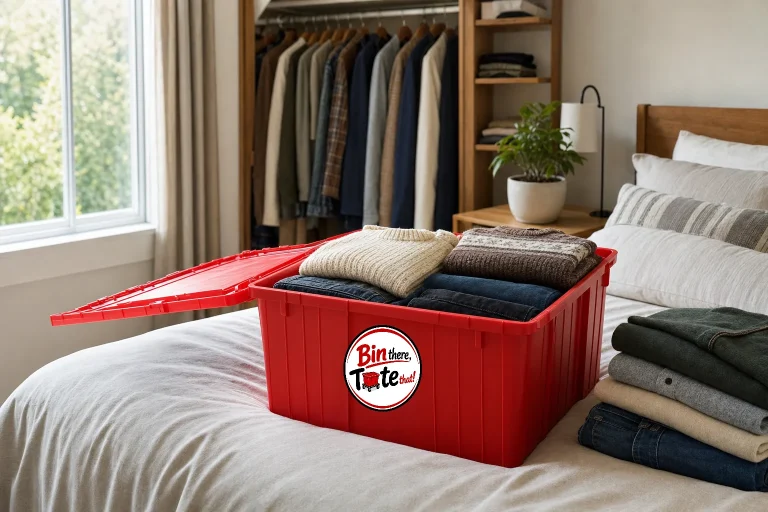
Here is the professional trick that makes a big library manageable: stop giving books their own containers. Lay one flat layer of books across the floor of many containers, then fill the rest with light, soft cargo: linens, sweaters, towels, pillows. Every load comes out at a civilized weight, the books ride cushioned on all sides, and the soft stuff stops rattling around half-empty boxes.
This works especially well with rented moving totes, since a full stack arrives at once and you can spread the library across twenty containers instead of cramming it into five. The 25-tote Essential Move package at $127 gives a typical one- or two-bedroom apartment enough floors to spread even a serious book habit, the hand truck comes standard for wheeling the heavy ones, and both delivery and pickup are free across the Portland and Vancouver metro. Package sizes are laid out on the tote package pricing page.
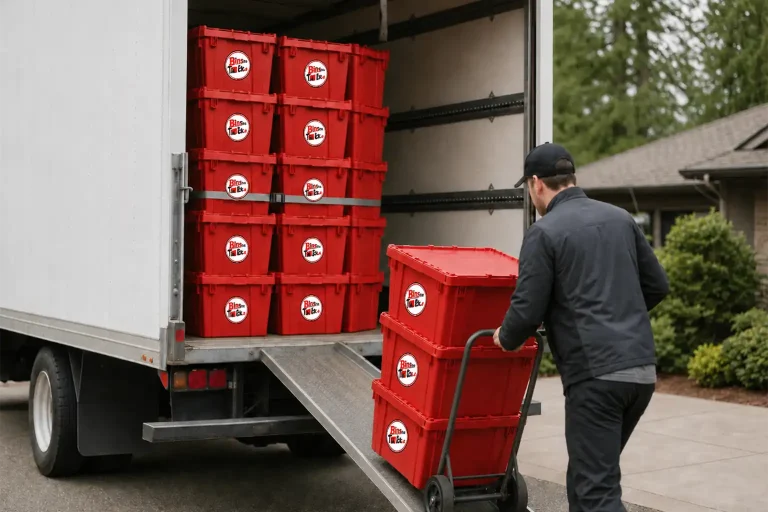
The hand truck deserves its own sentence: wheel book loads whenever the ground allows it. Your back is the one piece of moving equipment you cannot rent a replacement for. And if the route runs down exterior stairs in the wet half of the Portland year, a lidded plastic container has one more argument going for it: paper and drizzle should never meet, and a cardboard box of books left on a damp porch loses both its bottom and its cargo at once.
Loading, and the far end
In the truck, book containers behave like ballast, because they are. They go in first, low, against the front wall, and become the stable base other cargo leans on; the full sequence is covered in our guide to loading a moving truck. At the new place, direct every book container to the room with the shelves, and shelve them before the couch arrives if you can. Books unpack faster than anything else you own, and a full bookcase makes a bare room feel lived-in on day one.
If the library is packed, the hardest room is behind you. The fragile stuff comes next in our walkthrough on packing dishes and the kitchen, and the whole room-by-room sequence lives in our full moving guide library.

Written by the Bin There, Tote That! team
We rent, deliver, wash, and pick up moving totes across the Portland and Vancouver metro every week, so the advice here comes from vans and doorsteps, not a content mill. Facts about competitors are checked at publication and date-stamped in the text.