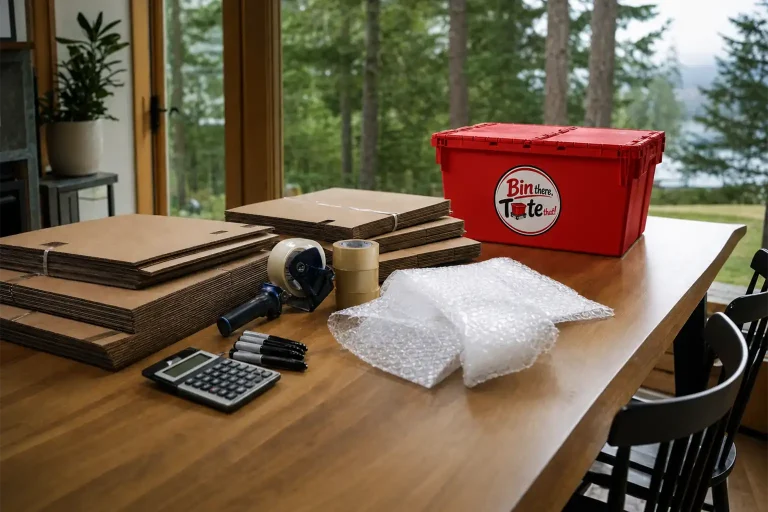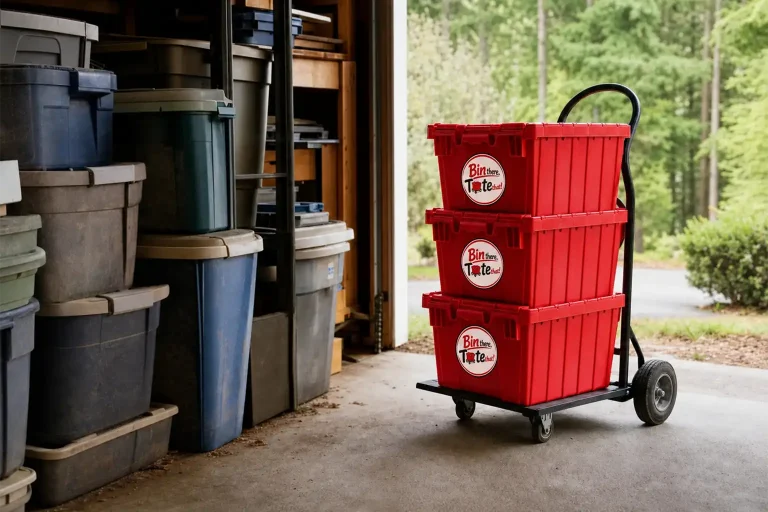
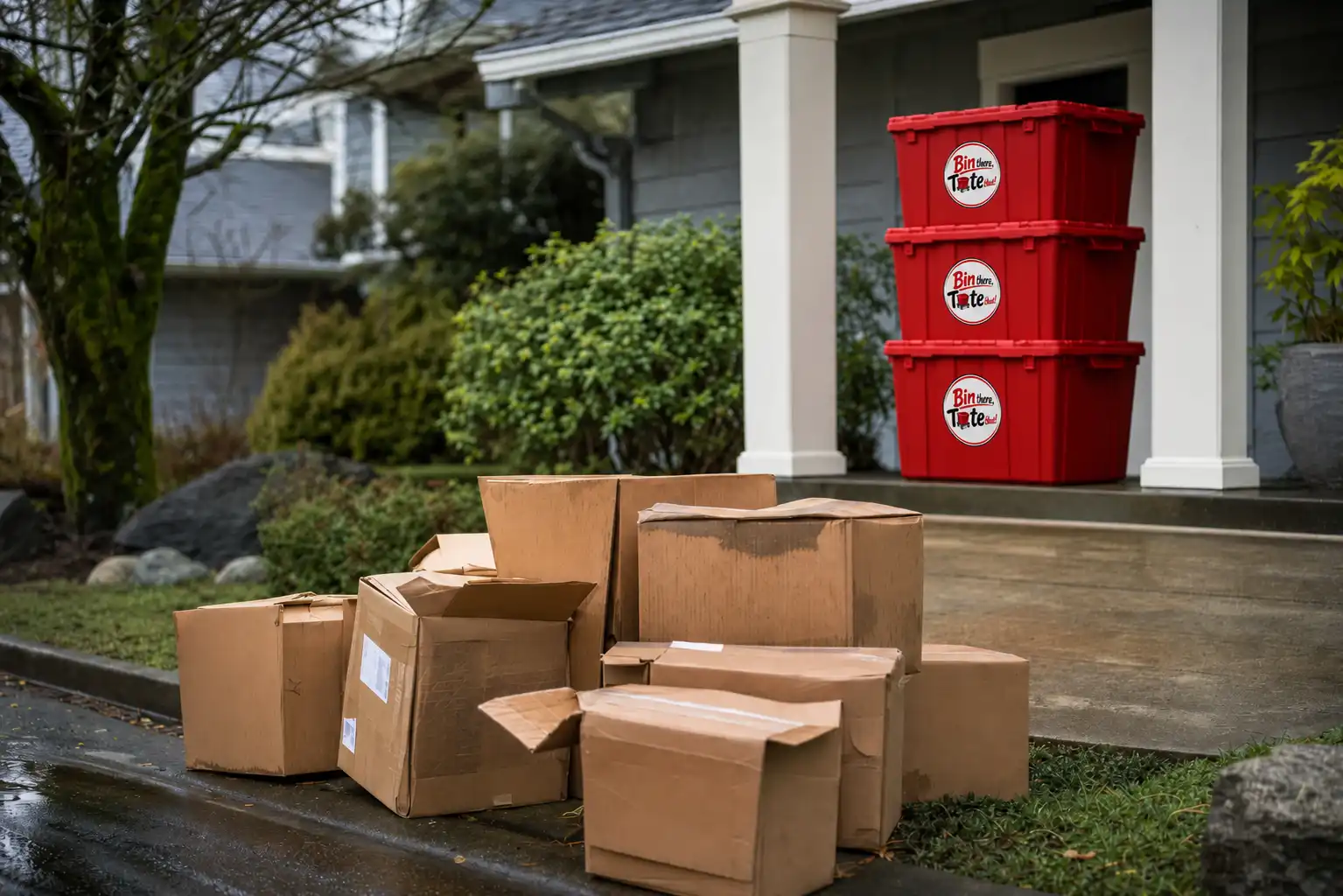
Free moving boxes from Craigslist, Facebook Marketplace, Buy Nothing groups, and liquor or grocery stores cost nothing in cash and plenty in everything else: hours of hunting and driving, mismatched sizes that stack poorly in a truck, and cardboard with an unknown history of moisture, mildew, and occasionally bed bugs. Renting plastic totes from Bin There, Tote That! trades those hidden costs for a flat $97 to $257, two weeks, delivered and picked up free across the Portland-Vancouver metro, as of July 2026.
For a dorm-scale move or a load of non-precious garage gear, free boxes are honestly fine. For a whole household on a deadline, sanitized uniform totes with guaranteed counts are the cheaper option once your time enters the ledger.
Where free boxes actually come from
Portland runs a thriving cardboard gray market. Craigslist free sections and Facebook Marketplace fill up every weekend with "moving boxes, gone by Sunday" posts. Buy Nothing groups pass the same thirty boxes around a neighborhood like a casserole dish. Liquor stores hand over sturdy little wine cartons if you catch the right shift, grocery stores break down produce boxes on a schedule you'll learn by trial, and apartment recycling rooms yield the occasional jackpot after someone else's move-in day. The supply is real, it's constantly replenished, and in a city this size it never fully runs dry.
All of it is genuinely free at the point of pickup, and we're not going to pretend otherwise. The question this page cares about is what the hunt charges you in the currencies that don't show up on a receipt: hours, gas, structural surprises, and the occasional passenger.
The hours ledger of a free-box weekend
Talk to anyone who furnished a move entirely from the free economy and a familiar timeline emerges.
- The listings sweep. Refreshing three apps, messaging five posters, hearing back from two. The good hauls go to whoever responds within minutes.
- The pickup circuit. Two or three cross-town drives, one flaky no-show, one porch pile that turned out to be half shoe boxes.
- The store rounds. Liquor store at opening, grocery back dock mid-morning, and a polite conversation each time about what's actually available today.
- The sort. Culling the crushed, the stained, and the mystery-smell candidates, which trims a fifty-box haul to a usable thirty-something.
- The top-up run. Because the culled haul never quite covers the house, someone ends up buying boxes anyway on packing day.
Call it several hours across multiple days, plus fuel, for inventory you can't spec in advance. Whether that trade is smart depends entirely on how much your hours are worth that particular week. Moving weeks are rarely the cheap ones.
Free is a price. It bills in hours.
Why a mismatched haul packs badly
The overlooked cost of scavenged cardboard is geometric. A haul assembled from wine cartons, banana boxes, printer-paper cases, and one giant TV box shares no common footprint, which means truck stacks turn into Jenga. Mismatched boxes leave voids, voids let stacks shift, and shifting is how a lamp ends up wearing a skillet by the time you cross the Marquam Bridge.
Uniform containers pack the way graph paper draws. Rental totes are one repeated footprint with lids that nest into the tote above, so rows come out even, columns bear weight predictably, and the load map of the truck stays boring, which is the highest compliment a truck load can earn.
The mismatch tax continues at the human level. Scavenged boxes come with no handles, open tops on produce boxes, and one absurd dimension apiece, so every carry is a fresh negotiation between your grip and a staircase. Molded handholds on a uniform tote mean the four-hundredth lift works exactly like the first, which your lower back will file under things that mattered more than the receipt.
The unknown-history problem
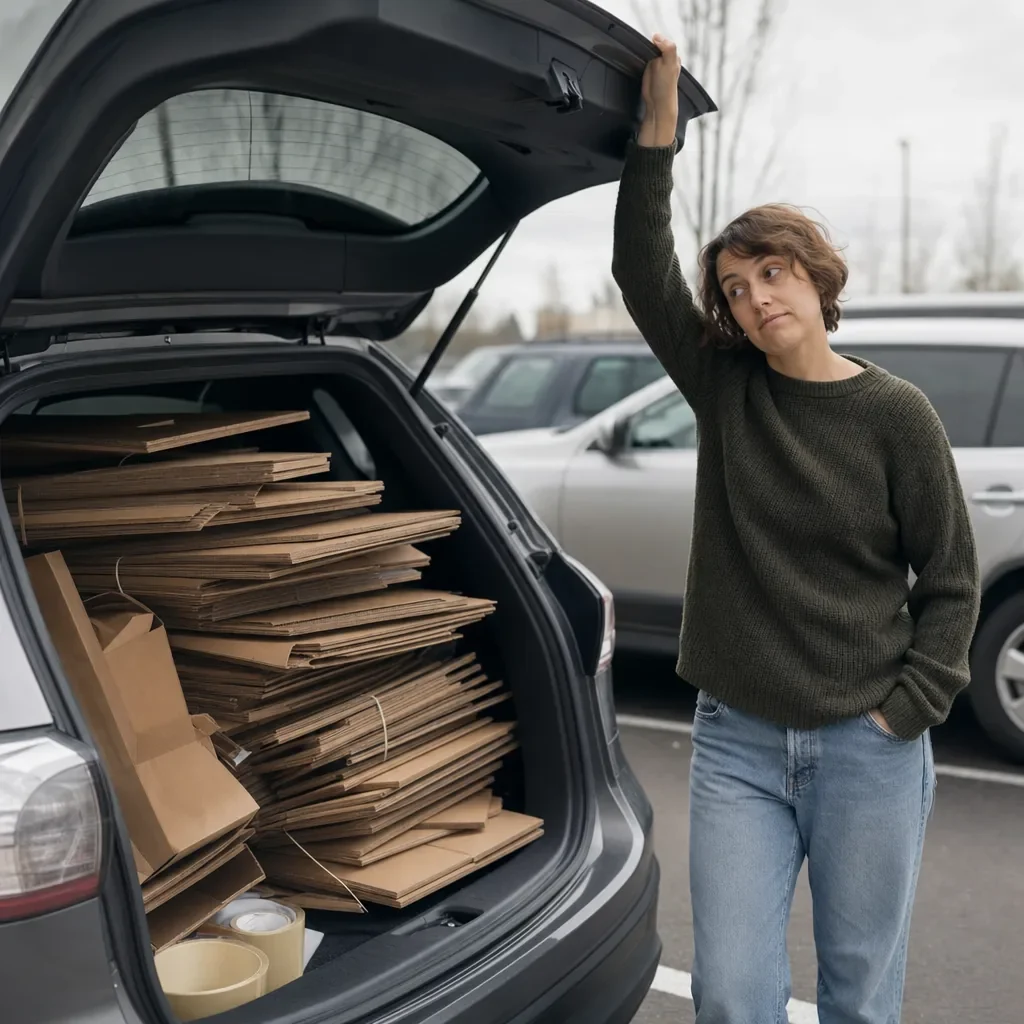
Every scavenged box has a past, and you weren't there for it. Grocery and produce boxes may have ridden refrigerated trucks and absorbed condensation that quietly halved their strength; board that's been wet and dried again looks fine and folds under load. Basement-stored boxes can carry mildew you'll smell only after your linens have. And used cardboard, especially from residential sources, is a known hitchhiking route for bed bugs, which travel happily in seams and flaps. It's a real enough risk that we wrote a separate guide to bed bugs and used moving boxes covering how to inspect a haul before it enters your home.
Rented totes flip that history problem into a feature: hard-sided plastic with no seams to shelter insects, washed and sanitized between every rental, with a condition you can verify at the door in about four seconds.
Scavenged boxes vs. rented totes, honestly scored
Both columns scored on what they actually deliver, not on sticker price alone.
| Measure | Free scavenged boxes | Delivered totes (us) |
|---|---|---|
| Cash outlay | Zero, and that's the whole pitch | $97 to $257 flat for two weeks |
| Time to acquire | Hours of listings, drives, and dock visits | One booking; the stack arrives free |
| Size consistency | Wine carton to TV box lottery | One uniform footprint, purpose-built to stack |
| Service history | Unknown; wet-dry cycles leave no visible record | Cleaned and sanitized before every rental |
| Pest exposure | Seams and flaps can carry hitchhikers | Seamless washed plastic; nowhere to hide |
| Supply certainty | Whatever the weekend coughs up | Counts guaranteed by package, extras on request |
| Gear | None included, obviously | Standard hand truck with every order |
| Afterward | Re-list them, or recycle the whole saga | Free pickup at the new place |
When free boxes are honestly the right call
Plenty of moves deserve the scavenger route, and we'd rather map them than wave them away.
The dorm-scale move. One carload of clothes, a monitor, and a milk crate of kitchen gear needs maybe eight boxes. Two liquor-store stops cover it, and even our smallest package would be overkill.
The non-precious load. Garage stuff, garden tools, camping gear, the bin of cables every household maintains for no reason. Nothing here fears a soft box or minds a little produce-aisle perfume.
The long-runway declutter. If you're boxing donations over a couple of months before listing the house, free boxes trickling in weekly match the pace fine. It's the deadline moves, the whole-household, dishes-and-heirlooms, lease-ends-Saturday moves, where the free economy's delivery schedule and quality control betray you. Scavenging rewards flexibility, and a hard move date is the least flexible thing most people ever schedule. For those, the totes are booked in five minutes; here's how delivery and pickup actually run.
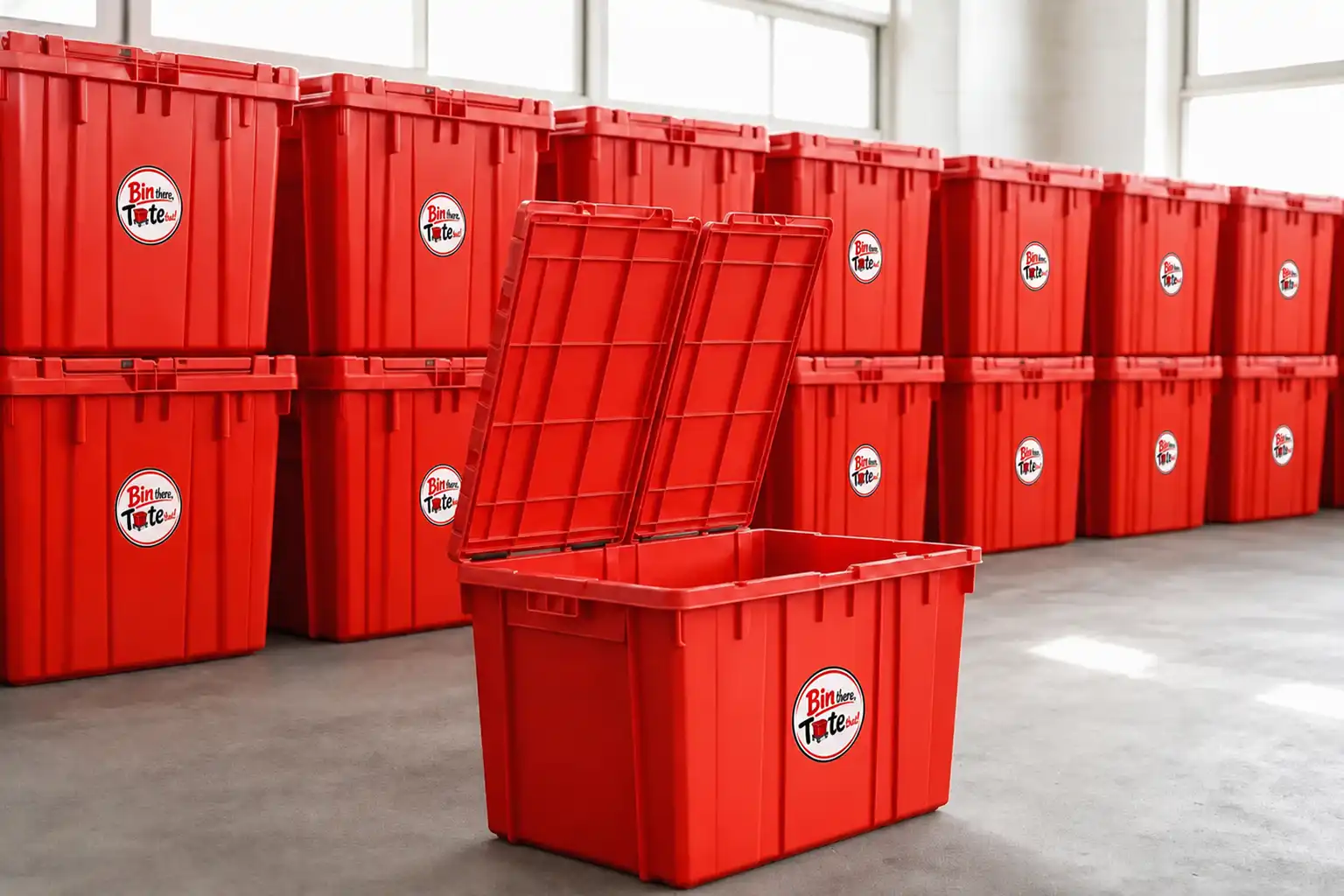
Scavenge or book?
A quick sorting hat for the free-box question. Answer it based on the move you're actually facing, not the one where everything goes smoothly, because moving weeks have never once heard of that one.
- The whole move fits in one car trip
- Nothing you're packing would make you wince if the box failed
- You genuinely enjoy the hunt and have weeks of runway
- Your move has a hard date and a full household behind it
- Dishes, electronics, or anyone's heirlooms are riding along
- The idea of a stranger's basement cardboard in your bedroom gives you pause
- You'd rather spend those hunting hours packing, or not moving at all
Free boxes are one corner of a bigger decision. See what delivered plastic totes include across the Portland and Vancouver metro, and for the material matchup underneath every version of this choice, settle the cardboard-or-totes question once.

Written by the Bin There, Tote That! team
We rent, deliver, wash, and pick up moving totes across the Portland and Vancouver metro every week, so the advice here comes from vans and doorsteps, not a content mill. Facts about competitors are checked at publication and date-stamped in the text.